Money and Power: The Bronze Coinage of Roman Procurators in the Time of Jesus
The bronze coins issued by Roman procurators mentioned in the New Testament offer us more than just archaeological artifacts – they provide a window into the complex political and religious dynamics of first-century Judaea. These small bronze pieces were the everyday currency that would have passed also through the hands of Jesus, his disciples, and the early Christian community. They represent the intersection of Roman imperial authority and Jewish religious sensitivities in a province that would become central to world history. Most of the procurators minted their coins while respecting the religious restrictions of their Jewish subjects, though some, like Pontius Pilate, were less diplomatic in their approach.
Pontius Pilate’s Controversial Coinage (26-36 CE)
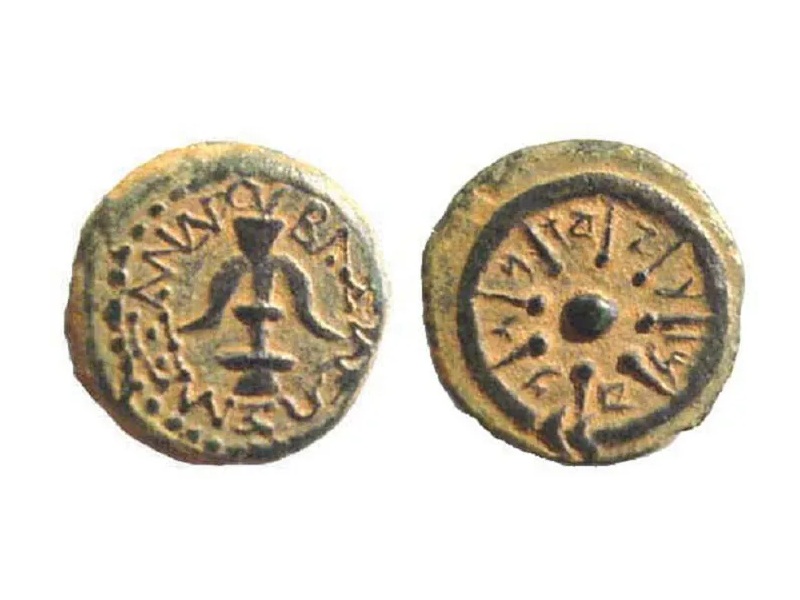
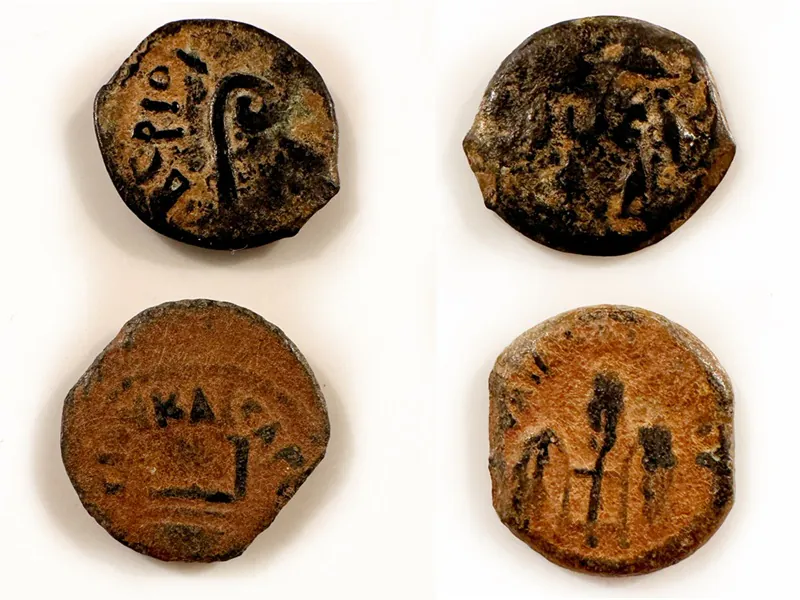 Pontius Pilate, the procurator most prominently featured in the New Testament accounts, minted bronze coins during three specific years of Tiberius’ reign – 29/30, 30/31, and 31/32 CE. His coinage marked a significant departure from previous procuratorial issues by incorporating distinctly Roman religious symbols. The obverse of his coins featured either three bound ears of barley or a lituus, the curved staff used by Roman augurs in their divination rituals. The reverse designs displayed either a simpulum, a ceremonial ladle used in Roman religious ceremonies, or a wreath containing the date. All these coins bore the Greek inscription “TIBEPIOY KAICAPOC” (of Tiberius Caesar). The use of these pagan cultic objects on his coinage may reflect Pilate’s documented insensitivity to Jewish religious customs, as mentioned by both biblical and extra-biblical sources.
The Coins of Felix: Imperial Politics in Bronze (52-60 CE)
Antonius Felix, who appears in the Acts of the Apostles in connection with Paul’s imprisonment, produced bronze coins during both the latter years of Claudius’s reign and the early years of Nero. His coins typically featured two crossed palm branches on the obverse with the inscription “NEP[WNOC]” (of Nero), while the reverse displayed “KAICAPOC” (Caesar’s) enclosed within a wreath along with the date. A notable variant from his tenure features palm branches with the inscription “BPIT” referring to Britannicus, Claudius’s son, highlighting the complex imperial politics of the period.
Festus: Continuing the Tradition (60-62 CE)
Porcius Festus, who succeeded Felix and also dealt with Paul’s case as recorded in Acts 25-26, continued minting bronze coins during Nero’s reign. His coinage maintained similar design elements to those of Felix, featuring palm branch motifs and the inscription “KAICAPOC NEP[WNOC].” These coins were dated according to Nero’s regnal years, providing important chronological markers for archaeological contexts.
Production and Historical Significance
The production quality of these procuratorial bronzes was generally inferior to contemporary Roman imperial issues, displaying crude engraving and often irregular flans. However, they served a vital economic function in daily transactions within Judaea, where small denomination bronze coins were essential for local commerce. The fact that these coins have survived in archaeological contexts throughout Israel, often in clear stratigraphic layers, helps confirm the historical chronology of these procurators and provides physical evidence of their administration.
These bronze issues represent more than just currency; they embody the complex relationship between Roman administrative authority and local Jewish sensibilities, often reflecting the delicate balance procurators had to maintain between imperial representation and local religious constraints.